
OPTASIA FOUNDATION • ROBOTICS PATHSHALA • BUILDING TOMORROW’S INNOVATORS
Robotics Pathshala:
Why Rural India’s Children Deserve a Seat at the Innovation Table
Bridging the Rural-Urban Innovation Gap Through Hands-On Robotics Education
By Optasia Foundation Team | March 2025 | Bareilly, Uttar Pradesh
In 2024, India launched its third indigenous space mission. Its defence sector deployed AI-powered surveillance drones along its borders. Its technology startups attracted over $10 billion in venture capital. The country is, by every measure, accelerating into a high-technology future.
And in a government school 80 kilometres outside Bareilly, a twelve-year-old boy named Deepak had never seen a robot.
These two realities India’s technological ambition and rural India’s technological exclusion exist simultaneously, separated not by oceans or borders, but by access, infrastructure, and the stubborn assumption that innovation is an urban privilege. Robotics Pathshala, Optasia Foundation’s flagship STEM initiative, was built to dismantle that assumption systematically, measurably, and permanently.
The Innovation Divide: Understanding the Gap
Before we can close the rural-urban innovation gap, we must understand exactly how wide it is and where its roots lie. The data paints a clear and sobering picture.
65% of India’s population — lives in rural areas yet less than 8% of STEM research output originates from rural institutions
1 in 25 rural government schools — has a functioning science laboratory, compared to nearly 9 in 10 urban private schools
92% of robotics & coding programmes — in India are concentrated in Tier 1 and Tier 2 cities
3.2x earnings premium — for workers with advanced STEM and digital skills over those without — a gap rural children are structurally excluded from
< 2% of rural Class 10 students — have been exposed to any form of computational thinking or engineering concepts before secondary school
These numbers reveal a fundamental inequity: the tools, experiences, and opportunities that build tomorrow’s innovators are overwhelmingly concentrated in cities. A child born in Mumbai or Bengaluru grows up surrounded by science museums, coding bootcamps, robotics clubs, and STEM fairs. A child born in rural Uttar Pradesh grows up with none of these not because they are less capable, but because the ecosystem simply does not exist around them.
Rural vs Urban: The STEM Access Divide at a Glance
The table below illustrates the structural disparity in STEM access between rural and urban schools in India:
Indicator | Urban Schools | Rural Schools |
Science lab availability | 87% | 4% |
Computer lab access | 79% | 11% |
Robotics / coding exposure | 34% | < 1% |
STEM-trained teachers | 61% | 9% |
Access to STEM competitions | High | Very Low |
Average tech spend per student | Rs. 4,200/yr | Rs. 180/yr |
The rural child is not behind because of talent. They are behind because of terrain the terrain of systemic neglect that has kept innovation a city-dwellers’ privilege for far too long.
What Happened When Deepak Saw His First Robot
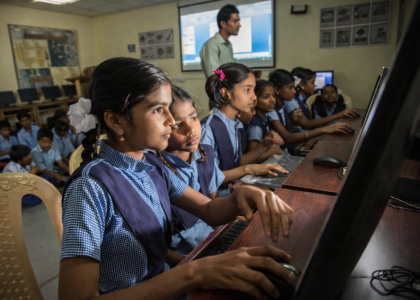
When Optasia Foundation’s Robotics Pathshala team arrived at Deepak’s school, they brought with them a set of entry-level robotics kits simple sensors, motors, wires, and a microcontroller board. Nothing expensive. Nothing that would look impressive in a well-funded private school lab.
But Deepak had never seen anything like it.
The volunteer instructor explained the challenge: build a small vehicle that can detect an obstacle and stop before hitting it. Deepak’s team had forty-five minutes, basic components, and no prior experience. They failed three times. On the fourth attempt, their small wheeled device rolled across the desk, sensed the wall of books placed in its path, and stopped.
Deepak stared at it for a long moment. Then he looked up and said, very quietly: “I made something think.” The volunteer said that in ten years of teaching, she had never seen a child look quite like that like the entire architecture of what was possible in his life had just been rebuilt from scratch.
Deepak went on to participate in Optasia’s district-level robotics showcase. His team built a simple automated irrigation model designed for small farms directly inspired by the agricultural challenges his own family faced. It won first place. More importantly, it was genuinely useful.
Why Robotics? The Evidence for Hands-On STEM Learning
Robotics education is not about producing robotics engineers though some students will go on to do exactly that. It is about using the making of robots as a vehicle for developing a cluster of skills that are foundational to success in the 21st-century economy.
Computational Thinking
When a child programs a robot, they learn to break a complex problem into smaller logical steps. This is computational thinking and research shows it transfers across subjects, improving performance in mathematics, science, and even language comprehension.
Iterative Problem-Solving
Robotics inherently involves failure. Components don’t connect. Code doesn’t run. Motors spin the wrong direction. Children learn, through direct experience, that failure is not an endpoint it is data. This reframing of failure is one of the most valuable mindset shifts education can deliver.
Collaboration and Communication
Robotics projects are almost always team-based. Children learn to divide responsibilities, communicate clearly, listen to peers with different ideas, and integrate multiple perspectives into a single solution skills that are directly valued in every modern workplace.
Real-World Relevance
Unlike textbook problems that feel abstract, robotics challenges can be anchored in the real world the students live in. Deepak’s irrigation robot was not an exercise it was a solution to a problem his family faces every monsoon. When learning is relevant, it sticks. And when it sticks, it changes trajectories.
Robotics Pathshala: The Programme in Detail
Optasia Foundation’s Robotics Pathshala is a structured, school-embedded programme designed to bring robotics and computational thinking to children in rural Uttar Pradesh. The programme is built around four pillars:
• Accessible Hardware — We use affordable, durable robotics kits appropriate for the infrastructure realities of rural schools no air-conditioned labs required, no high-speed internet dependency.
• Trained Volunteer Instructors — Every session is led by trained volunteers, many of them engineering students and working professionals, who bring both technical knowledge and genuine enthusiasm for teaching.
• Curriculum Contextualisation — Our challenges and projects are designed around problems rural students actually understand agriculture, water management, local transportation making the learning immediately meaningful.
• Competitions and Showcases — We run regular district-level robotics showcases where students present their projects publicly, building confidence, communication skills, and community pride simultaneously.
The programme intentionally avoids a one-time-event model. Single-visit interventions produce excitement but rarely produce change. Robotics Pathshala embeds itself into school calendars across multiple sessions, building skills progressively and allowing students to develop genuine proficiency over time.
The Bigger Picture: Rural Innovation as National Strategy
India’s National Education Policy 2020 explicitly identifies computational thinking, coding, and vocational STEM skills as priorities from the primary level upward. The government’s vision for a technology-led economy by 2047 Viksit Bharat depends on a workforce that is digitally capable, scientifically literate, and innovation-ready.
But that vision has a structural problem: it cannot be achieved by urban India alone.
India’s demographic dividend the enormous working-age population that economists point to as the country’s greatest economic asset is overwhelmingly rural. If that population enters the workforce without STEM skills, without computational literacy, without exposure to the problem-solving mindset that drives innovation, India’s technology ambitions will be built on a foundation with a massive crack running through it.
Robotics Pathshala is not just an education programme. It is, in a very real sense, infrastructure for India’s future. Every rural child who learns to think computationally, to build iteratively, to solve problems collaboratively is a node in the innovation network that India desperately needs to build.
How You Can Help Bridge the Gap
The rural-urban innovation gap is wide. But it is not immovable. Every robotics kit that reaches a rural school, every trained volunteer who walks into a classroom, every child who stands at a showcase and presents a project they built with their own hands narrows that gap measurably.
Here is how you can be part of closing it:
• Donate — Fund robotics kits, volunteer training, and programme delivery in rural schools. Even a modest contribution equips an entire team of students.
• Volunteer — Engineers, coders, designers, and educators: your skills are exactly what Robotics Pathshala needs. Become an instructor.
• Corporate Partnership — CSR funding from technology and manufacturing companies can scale Robotics Pathshala dramatically. Let us build this together.
• Advocate — Push for rural STEM inclusion in policy conversations, in your workplace, in your community. The innovation gap closes faster when more people refuse to accept it.
“India will not reach its technological potential by educating only its cities. The next great Indian innovator might be sitting right now in a village classroom — waiting for someone to hand them the tools.”
— Optasia Foundation, Robotics Pathshala
Optasia Foundation, Bareilly, India • Robotics Pathshala: Building Tomorrow’s Innovators