
OPTASIA FOUNDATION • TECH BETIYAN • GIRLS IN STEM
She Opened the Laptop and
the World Opened Back
Tech Betiyan: Closing the Gender Gap in STEM, One Girl at a Time
By Optasia Foundation Team | March 2025 | Bareilly, Uttar Pradesh
Aanya had never touched a computer before the age of thirteen. Not because she wasn’t curious, she was endlessly, hungrily curious. But in her village outside Bareilly, computers existed in the same category as aeroplanes and five-star hotels: things that belonged to a different kind of life. A life, she had been told in a hundred quiet ways, that was not meant for her.
The first time an Optasia Foundation volunteer placed a laptop in front of her, Aanya did not reach for it immediately. She looked at it the way you look at something you have wanted for so long you are almost afraid to want it.
Then she opened it. And the world opened back.
This is the story of Tech Betiyan — Optasia Foundation’s mission to bring girls in rural India into the world of science, technology, engineering, and mathematics. Not as an afterthought. Not as a quota. But as the brilliant, deserving, world-changing force they have always been.
A Room Full of Men — and the Girls Who Were Never Invited In
Picture the engineering departments of India’s top universities. The boardrooms of its technology companies. The research labs where the future is being coded, calculated, and built. Now ask yourself: how many women do you see?
The answer, even in 2025, remains deeply uncomfortable. India has one of the most severe gender gaps in STEM in the world and the roots of that gap don’t start in universities or workplaces. They start much, much earlier. They start in villages like Aanya’s, where a girl’s curiosity is quietly discouraged before it ever gets the chance to become ambition.
The numbers tell a stark story:
- 43% — India’s female share of STEM graduates, one of the highest globally. And yet
- 14% — the proportion of women actually employed in India’s tech and engineering sectors
- < 5% — women in senior leadership roles in Indian technology companies
- 1 in 3 — rural girls who have never accessed a computer or the internet before secondary school
- 2x — how much more likely a rural girl is to drop STEM subjects by Class 9 compared to her urban peers
The pipeline isn’t broken at the top. It is broken at the very beginning in the moment a girl is handed a broom instead of a book, or told that maths is “not for girls like you.”
What Aanya Did Next Changed Her Entire Village
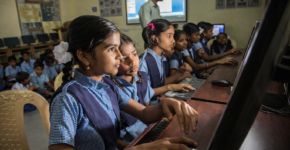
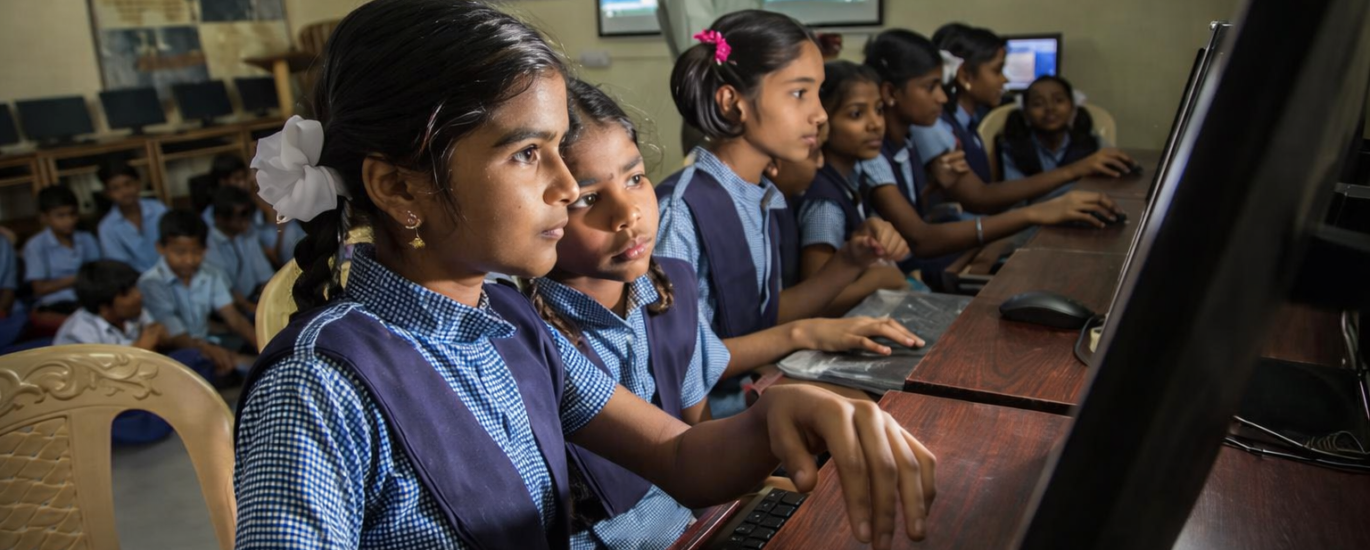
Back to Aanya. The laptop was open. A volunteer was beside her, patient and unhurried, showing her how to navigate a simple coding interface designed for beginners.
Aanya made the cursor move across the screen. She typed her name and watched it appear in glowing letters. She laughed a short, surprised sound, like something had caught her off guard. Then she leaned forward, and she didn’t lean back for the rest of the afternoon.
Over the following weeks, Aanya learned the basics of digital literacy through Optasia’s Tech Betiyan programme. She learned how to use productivity tools, how to search for information, how to present her ideas visually. She entered a district-level digital creativity competition her first ever and placed second.
“When I won that prize,” she said, “my father looked at me differently. Not like I was his daughter who was good at school. Like I was someone who could do something he didn’t understand. That felt like power.”
But the most remarkable thing Aanya did came months later. She started teaching other girls in her neighbourhood — unofficial, after-school sessions in her home, using the skills she had learned. Word spread. Parents who had been skeptical started sending their daughters. A girl who had never touched a computer became, at fourteen, a teacher of technology.
Why STEM? Why Now? Why These Girls?
Some people ask: why focus on STEM specifically? Isn’t any education valuable?
Yes all education is valuable. But STEM education carries a particular kind of power in the world we are building right now. The jobs of the next generation — the careers that will define India’s economy, its innovation, its place in the global future are overwhelmingly going to be rooted in technology, data, engineering, and science.
If girls are not in that room, India doesn’t just lose half its potential workforce. It loses half its potential ideas. Half its problem-solving perspectives. Half its innovation.
The Diversity Dividend
Research consistently shows that diverse teams — teams that include women, people from varied backgrounds, different ways of thinking produce better outcomes. More creative solutions. More robust products. More human technology. When girls from rural India enter STEM, they don’t just benefit themselves. They make the entire field better.
The Economic Argument
A girl with STEM skills earns more, builds more financial independence, and contributes more to her family’s economic stability than almost any other pathway available to her. In a country where women’s economic participation is already low, STEM is not a luxury — it is a ladder.
The Role Model Ripple
Every girl who enters STEM becomes visible proof that it is possible. She is the mirror that the next girl needs to see herself in. Aanya teaching her neighbours wasn’t an accident — it was a ripple. One girl’s breakthrough becoming another girl’s beginning.
What Tech Betiyan Actually Does
Tech Betiyan is Optasia Foundation’s dedicated initiative to bring STEM exposure, skills, and inspiration to girls in rural Uttar Pradesh. It is hands-on, community-rooted, and built around one simple belief: given the right environment, every girl can thrive in STEM.
Here is how we make it real:
• Digital Literacy Workshops — We introduce girls to computers, tablets, and the internet — many for the very first time through structured, joyful, hands-on sessions led by trained volunteers.
• STEM Exposure Events — Science demonstrations, mathematics puzzles, coding introductions, and engineering challenges that make STEM feel exciting, accessible, and fun.
• Mentor Matching — We connect girl students with women working in technology, science, and engineering — so they can see, in flesh and blood, what their future could look like.
• School Competitions — District-level STEM competitions that give girls a public stage to showcase their skills, build confidence, and earn recognition.
• Family Awareness Sessions — We work with parents and community members to shift the narrative around girls in STEM because a girl’s ambition needs her family’s support to survive.
The Gap Is Not About Ability. It Never Was.
Let us be clear about something: the gender gap in STEM is not because girls cannot do science or mathematics. That is a myth so thoroughly debunked it is almost embarrassing that it still circulates.
Girls perform equally to boys and often outperform them — in STEM subjects when given equal access, equal encouragement, and equal belief. The gap exists not in girls’ minds but in the systems, attitudes, and structures that surround them.
It exists in the textbook that shows only male scientists. In the teacher who calls on the boys more often without realising it. In the parent who buys his son a toy robot and his daughter a toy kitchen. In the school that has a computer lab but implicitly signals through a hundred small gestures that it is not really for the girls.
“The most dangerous phrase in any language is: this is not for you. Tech Betiyan exists to replace that phrase with: this was always for you. We just needed to open the door.”
Open the Door With Us
Aanya is not exceptional. She is what every girl can be when someone believes in her enough to place a laptop in front of her and say: this is yours. Go ahead. Try.
Tech Betiyan needs your support to reach more Aanyas — in more villages, more schools, more communities across rural India.
• Donate — Fund digital devices, STEM materials, and workshop programmes that put technology directly in girls’ hands.
• Volunteer — Are you a woman in STEM? Your story is the most powerful thing you can share. Become a Tech Betiyan mentor.
• Partner — Tech companies, educational institutions, and CSR programmes let’s build this together at scale.
• Spread the word — Share this story. Tag a woman in STEM who inspires you. Make the invisible visible.
“Somewhere in rural India, a girl is waiting to open her first laptop. She doesn’t know it yet — but when she does, she will change everything.”
— Optasia Foundation, Tech Betiyan
 contact@optasia.in |
  +91 9473513973 |
  optasia.in
Optasia Foundation, Bareilly, India • Tech Betiyan: Girls in STEM