
OPTASIA FOUNDATION • A STORY INDIA NEEDS TO HEAR
The Children We Almost Forgot:
The Heart-Breaking Reality of Rural Education in India — and the Hope Rising Against It
By Optasia Foundation Team | March 2025 | Bareilly, Uttar Pradesh
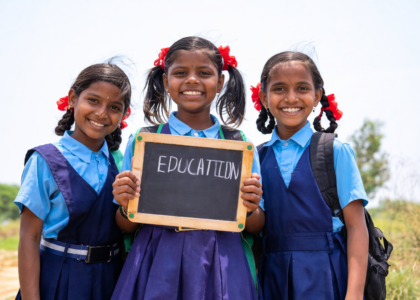
There is a village in Uttar Pradesh where the school bell rings every morning at 8 AM. Children come running — barefoot, backpacks bouncing, faces bright with the kind of hope that hasn’t yet learned to be afraid. But by the time they reach Class 5, nearly half of them will quietly disappear from those classrooms. No farewell. No ceremony. Just — gone.
This is not fiction. This is the lived reality of millions of children across rural India. And it is a story that doesn’t get told nearly enough.
At Optasia Foundation, we have walked into those villages. We have sat in those classrooms. We have looked into those children’s eyes. And we have made a promise — that we will not look away.
A Crisis Hidden in Plain Sight
India is home to the world’s largest population of children. Over 250 million students are enrolled in schools across the country. On paper, that’s a triumph. In reality, for millions of rural children, school enrollment is just the beginning — and often, the end — of their educational journey.
The numbers are staggering, but it is the human cost that truly breaks your heart:
• Millions of children in rural India cannot read a simple sentence by Class 3
• Dropout rates spike sharply after primary school, especially among girls
• Many rural schools have a single teacher managing five different grade levels simultaneously
• Families often pull children out of school during harvest seasons to earn extra income
• A child in rural India has, on average, a fraction of the educational resources available to a child in an urban centre
These are not just statistics. Each number is a child who deserved better. A child whose curiosity was never nurtured. A child whose question was never answered. A child who stopped believing that school was meant for someone like them.
Meet Sunita. She Was Eight When She Stopped Going to School.
Sunita lived in a small hamlet outside Bareilly. Her father was a daily-wage labourer. Her mother managed the household. When the monsoon came and work dried up, Sunita was kept home to help. One missed week became two. Two weeks became a month. A month became forever.
No one came looking for her. No one asked why the little girl with the bright eyes had stopped appearing at the school gate. The system was simply too stretched, too underfunded, too overwhelmed to notice one missing child.
Stories like Sunita’s are not rare. They play out every single day, in every district, in every state where poverty and lack of educational support collide. The tragedy is not just what these children lose — it is what the entire nation loses when a generation’s potential is left unfulfilled.
Why This Happens — The Roots Run Deep
To solve a problem, you have to understand it. Rural education in India doesn’t fail because of one single issue — it fails because of a web of interconnected challenges that reinforce each other every day.
The Infrastructure Gap
Many rural schools lack basic amenities — proper roofs, clean drinking water, functioning toilets (a key reason girls drop out), and electricity. When a child sits in a dark, leaking classroom in the middle of summer, learning becomes a physical battle before it even becomes an intellectual one.
The Teacher Shortage
Rural postings are often seen as punishment assignments. Trained teachers prefer cities. What remains is an overstretched, sometimes undertrained teaching force trying to hold classrooms together with limited resources and even less support. A single teacher managing 60 students across three grade levels cannot give any one child the attention they deserve.
The Economic Pressure
For families living on the edge, children are an economic unit. Every hour a child spends in school is an hour they are not helping at home, not earning in the field, not caring for a younger sibling. Education feels like a luxury when survival is the immediate concern.
The Aspiration Gap
Perhaps the most invisible — and most damaging — barrier is the aspiration gap. When a child has never met a doctor, engineer, or teacher who grew up in a village like theirs, it is very hard for them to believe that path exists for them too. Dreams require mirrors. Without role models, hope fades quietly.
But Here Is What We Also Know: It Doesn’t Have to Be This Way.
For every heartbreaking statistic, there is a counter-story. A child who stayed in school because a volunteer came to mentor them. A girl who stood up to speak at a school event and discovered her own voice. A boy who placed in a district science competition and made his entire village proud.
Change is possible. We have seen it. We have been part of it.
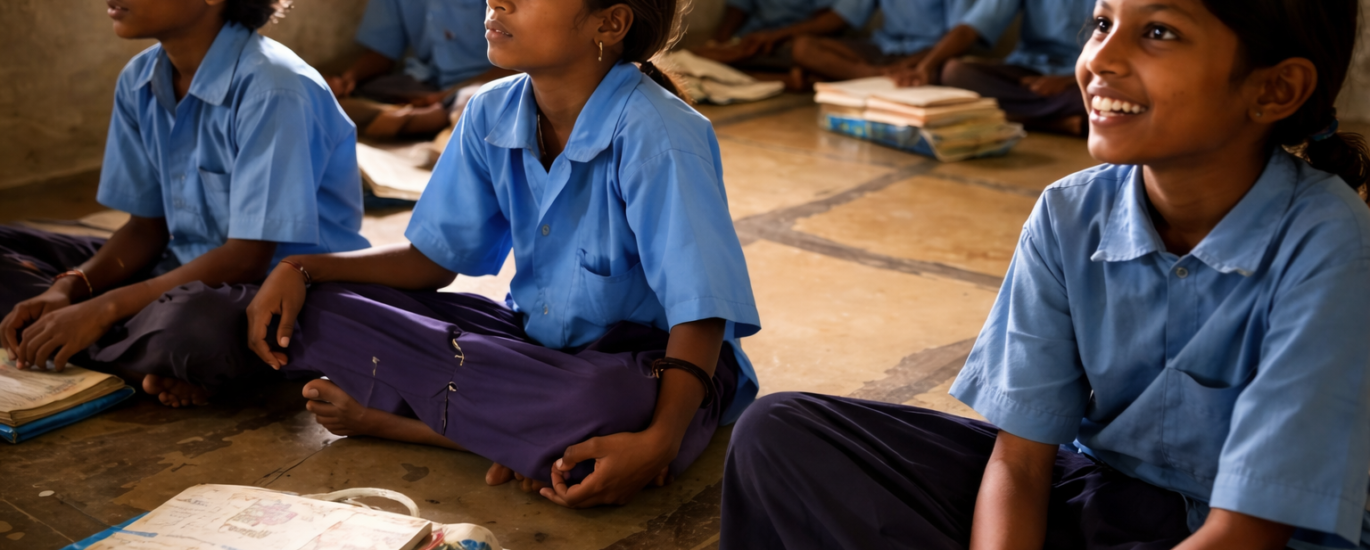
When Optasia volunteers walked into a school in rural Bareilly, they didn’t bring pity. They brought pencils and passion. They sat on the floor with children and said: “We are here. You matter. Your future is worth fighting for.” That is how transformation begins — not with grand gestures, but with presence.
What Optasia Is Doing — One Village at a Time
Over the past three years, the Optasia Foundation has been building a model that works — not because it is flashy, but because it is grounded in community, trust, and a genuine love for children.
• We show up. Our 1,000+ volunteers go directly into schools — sitting with students, supporting teachers, and making learning come alive.
• We partner deeply. We work with 100+ schools not as outsiders, but as invested members of the community.
• We celebrate children. Through school events, competitions, and workshops, we give children a stage to shine on.
• We think long-term. Our 20+ community projects are designed for sustained impact, not quick wins.
• We focus on the forgotten. Girls, first-generation learners, and children from the most marginalised families are at the heart of our work.
Sunita’s Story Isn’t Over Yet.
Remember Sunita — the eight-year-old who quietly disappeared from her classroom? When Optasia volunteers conducted a community outreach drive in her village, they found her. They spoke with her family. They didn’t lecture or judge; they listened, and they helped find a way.
Today, Sunita is back in school. She is eleven years old, two years behind her peers, and absolutely determined to catch up. She wants to be a teacher someday — so that no child in her village ever feels invisible again.
That is the power of showing up. That is the Optasia promise.
Will You Show Up Too?
The education crisis in rural India is vast. But it is not hopeless. It is not unsolvable. It yields — slowly, beautifully — to love, attention, and sustained effort.
You don’t have to move to a village to make a difference. You just have to care enough to act.
• Donate today — fund learning materials, school events, and volunteer programs that directly reach children in need.
• Volunteer with us — give your time, skills, and heart to a cause that will outlast all of us.
• Share this story — because awareness is the first step. Tell someone. Post it. Shout it.
• Partner with Optasia — if your organisation wants to create real, measurable social impact, let’s build it together.
“The children of rural India are not the problem. They are the solution — if only we give them the chance.”
— Optasia Foundation